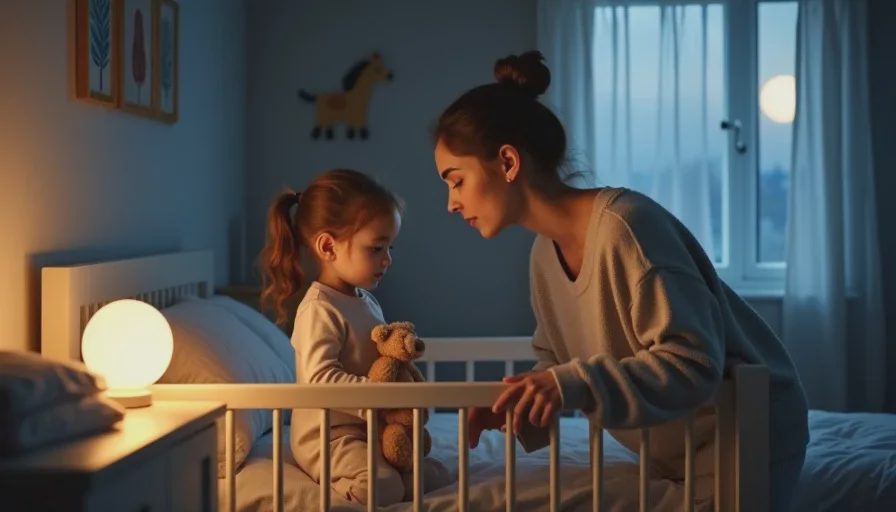
If you're awake at 3 a.m. with a two-year-old who has suddenly, urgently, completely decided it's daytime, you're probably wondering whether this is a 2 year old sleep regression and how long it lasts. I'm writing this from inside it, mostly. Mae has woken at 3 a.m. about six nights out of the last ten. Some nights she settles in twenty minutes. Other nights she wants to talk about the vacuum cleaner for an hour. I've logged every single wake-up in the toddler field notebook, and I can give you the honest version: it's hard, it's normal, and it does end.
What 3 a.m. Actually Looks Like at Our House
The first few times, I assumed something was wrong — she was sick, she was scared, she was hungry. Most nights, it's none of those. Mae sits up in the dark like a tiny lighthouse and announces herself. By the time I'm in her room, she's standing in the crib, running through her list: a book, water, the bear, the door open, the door closed. The order changes nightly. The list doesn't. What I've learned is to stop hunting for a single cause on any given night and instead watch the pattern across two weeks. That's what the notebook is for, and it's the same shorthand I used for my classroom kids.
What I log (and what I don't)
The time and the length. When she woke, and how long it took to settle. This tells me whether a rough stretch is actually getting better.
What worked and what made it worse. One week I tried staying in the rocking chair until she fell asleep. It was a mistake, and the notebook caught it within four nights.
The day before. Nap length, bedtime, and whether something big happened — a new playground, a cousin's visit, an extra-long afternoon at the library.
I don't log the hard feelings, because I already know those by heart. The notebook is for facts, and facts are what turn a terrifying pattern into a temporary one.

What's Actually Happening at This Age
Here's the part that helped me sleep on the nights Mae didn't: the 3 a.m. wake-up at two is usually not a problem to be solved. It's development showing up in the middle of the night. The phrase "sleep regression" makes it sound like your child's sleep is sliding backwards, but most of the time it's forward motion — new skills, new feelings — surfacing at the one hour when there's nothing else to do and nobody else to talk to.
The three usual suspects
Separation anxiety. Two-year-olds carry enormous feelings about who is close and who isn't. At 3 a.m., with no toys and no daylight, that feeling has nowhere to go.
Cognitive leaps. New words, new pretend games, a new understanding of how the world works — a brain that spends all day learning tends to stay busy at night.
Dreams. Sleep cycles at this age include more vivid dreaming. Waking between cycles is ordinary; what's new is that a two-year-old can't yet drift back to sleep on her own.
Survival Strategies That Don't Require Choosing a Camp
You don't have to pick a side in the sleep-training debate to survive this stretch. I've never landed in one camp, and I don't think you need to either. What you need is a plan everyone in the house can live with, repeated often enough that the plan becomes boring. That's the whole strategy.
The middle-of-the-night script
Same words, same order, same volume. Ours is three sentences long. Mae can practically recite it now, which is exactly the point.
Keep the room boring. Lights low, voice quiet, no new books from the shelf, no trips to the kitchen.
One adult, one visit. Decide who goes in. That person does the script and comes back out. Two parents standing in the doorway reads as a party.
Tag in by night. Mike and I split the wake-ups so neither of us carries the whole week. Knowing I'll sleep tomorrow night makes tonight survivable.
When you're both too tired to think
There are nights the script falls apart, and that's okay. On those nights, we pick whatever gets the most people back to sleep fastest — even if it's not the plan. One extra cuddle is not a broken habit. A habit is built by weeks of repetition, not by one tired Wednesday.
Mike's Job (and Mine)
This is the part I couldn't do without: Mike is the normal-parent sanity check. At 2 a.m., I am convinced the 2 year old sleep regression is permanent and we'll be doing this until college. Mike, who sleeps in a way I can only describe as athletic, looks at me and says, "She's two. She's fine. Go to sleep." It's infuriating. It's also usually right. Our system is simple: he handles the 3 a.m. wake-up twice a week, I handle the rest, and whoever is off duty does not get to be awake. That boundary has done more for us than any technique we've tried.
It Passes
I want to end where I started: this is hard, and it's temporary. Mae's last rough stretch ran about three weeks, then faded the way they all do — one night she simply didn't wake up, and I almost didn't believe it. There will be another stretch somewhere down the road, because two-year-olds keep growing, and growing shows up at bad hours. The notebook will be waiting. So will the script, and so will Mike. If you're in the middle of a 2 year old sleep regression right now, I know how the math looks at 4 a.m. It's a season, not a race. And at 3 a.m., it helps to remember the season has an ending.



Travellers Write
No letters yet — be the first traveller to write.