In my preschool classroom, we didn't use flashcards. We didn't do worksheets. We didn't drill letters or numbers. What we did was play — intentionally, with materials chosen to build specific skills — and by the end of the year, those kids could count, recognize letters, hold a pencil, negotiate with peers, and solve simple problems. Play wasn't a break from learning. Play was the curriculum. Now that I'm home with Mae, I approach toddler activities at home the same way. Here are 10 activities I use with Mae that build real developmental skills, and how to set them up.
Why Play Is Real Learning
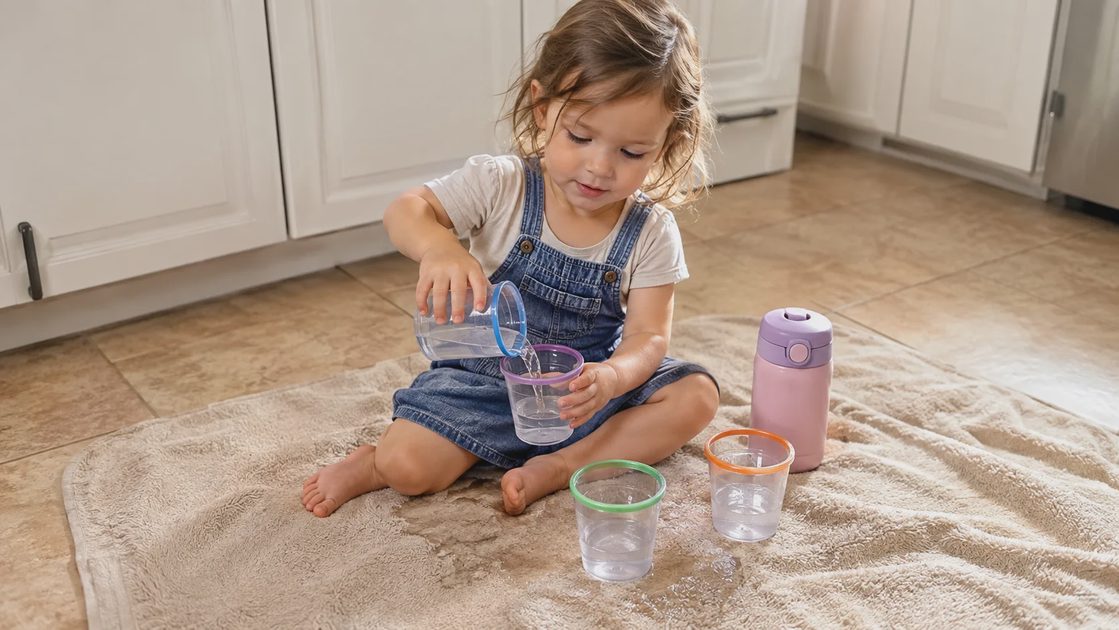
Before I share the activities, let me explain why I'm skeptical of the flashcard approach. Flashcards teach rote memorization — a child can learn to say "A is for apple" without understanding what a letter is or why it matters. Play teaches through experience. When a toddler pours water from one cup to another, they're learning volume, cause and effect, fine motor control, and spatial reasoning — all at once, and all through their own discovery.
Research in early childhood education consistently shows that play-based learning in the first five years builds stronger cognitive and social foundations than direct instruction. I saw this in my classroom for 8 years, and I see it with Mae every day. The kid who plays is the kid who learns.
Why I Don't Buy the "More Academic Earlier" Approach
There's a push in our culture to make early childhood more academic — letter of the week, tracing sheets, structured lessons at 2 and 3. I understand where it comes from. Parents are anxious about school readiness, and flashcards feel productive. But in my experience, the kids who arrived in my classroom with the strongest skills weren't the ones who'd been drilled at home. They were the ones who'd been allowed to play, explore, and follow their curiosity. When I plan toddler activities at home for Mae, I'm not thinking about what she should "know." I'm thinking about what skills she should be building — and play builds all of them.
10 Activities That Build Real Skills
Here's the full list of activities I rotate through with Mae. Each one targets a specific developmental area, and none of them require special equipment.
# | Activity | What It Teaches | What You Need |
|---|---|---|---|
1 | Water pouring station | Fine motor, volume, cause and effect | 3-4 cups, water, a tray |
2 | Dot sticker line-up | Fine motor pincer grasp, one-to-one correspondence | Dot stickers, paper, marker |
3 | Sorting by color | Categorization, cognitive sorting | Colored objects, bowls |
4 | Animal sound matching | Language, auditory discrimination | Animal figurines or pictures |
5 | Blanket fort reading nook | Social-emotional, spatial awareness, literacy | Blanket, chairs, books |
6 | Play-dough with tools | Hand strength, creativity, sensory processing | Play-dough, rolling pin, cookie cutters |
7 | Nature tray exploration | Science observation, vocabulary | Leaves, rocks, pinecones collected outside |
8 | Scarf peek-a-boo | Object permanence, social bonding | A lightweight scarf or cloth |
9 | Tape rescue | Fine motor, problem-solving | Painter's tape, small toys |
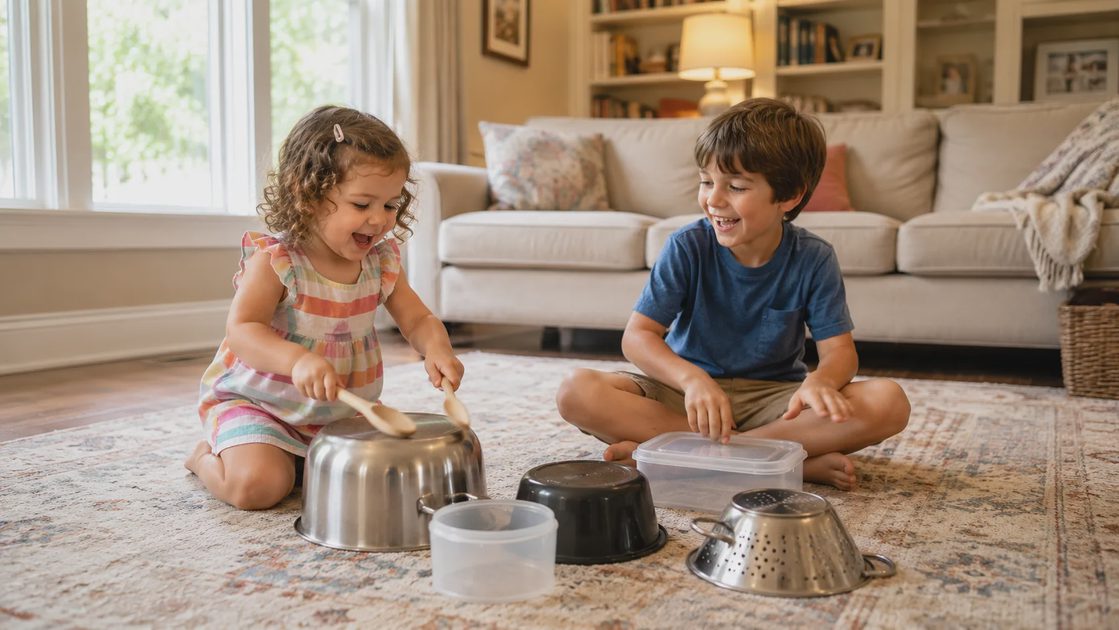
10 | Kitchen drum band | Rhythm, auditory processing, motor planning | Pots, wooden spoons, containers |
How Each Activity Works
Let me walk through a few of these in detail so you can see what the learning looks like.
Water pouring station. I put three cups and a small pitcher of water on a towel on the kitchen floor. Mae pours water from the pitcher into the cups, back and forth, for 20-30 minutes. She's learning how to control her hand movements, what happens when a cup overflows, and how water behaves. She thinks she's just playing with water. She's doing a science experiment.
Dot sticker line-up. I draw a line on a piece of paper and put dot stickers next to it. Mae peels the stickers off and places them along the line. Peeling stickers is hard for a 2-year-old — it requires the pincer grasp (thumb and forefinger), which is the same muscle group used for writing later on. This activity is pure fine motor work disguised as stickers.
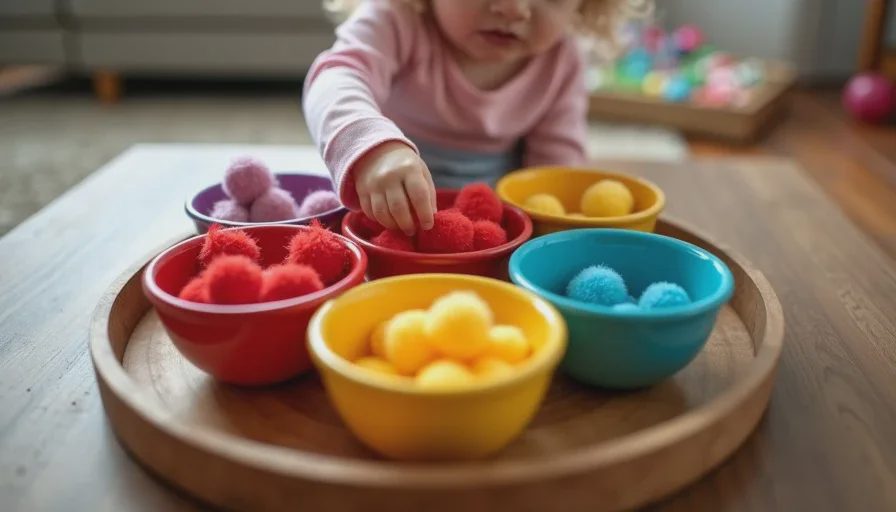
Sorting by color. I put out a bowl of colored pom-poms and three colored bowls. Mae sorts them by color. Sometimes she sorts them by size instead, which is fine — she's categorizing, which is a foundational math skill. The point isn't getting it "right." The point is the act of sorting and noticing attributes.
Tape rescue. I tape a few small toys to the floor or a tray with painter's tape. Mae picks at the tape to free the toys. It's gripping work — she has to use her fingertips to find the edge of the tape, pull it up, and peel it back. It builds persistence, problem-solving, and those same fine motor muscles.
How to Set Up Without Losing Your Mind
The mistake I see most often — and made myself early on — is trying to set up Pinterest-worthy activity stations. You don't need a curated setup. You need a tray, a towel, and whatever you already have in your kitchen. Here's my approach:
Pick one activity per day, not five. Rotate through the list over two weeks.
Set it up while Mae is in her high chair eating a snack. By the time she's done, the activity is ready.
Put it on the floor with a towel underneath. Low expectation for mess.
Let her lead. If she wants to pour water into the play-dough instead of the cups, that's fine. The activity is still valuable.
Clean up together. "Now we put the cups back in the cabinet" is a skill too.
What Play Looks Like in Our House
On a typical morning, Mae gets one activity after breakfast. I set it up, she plays for 15-30 minutes, and then we move on to whatever the day holds — a walk, the library, or just free play in the living room. I don't structure her whole day around activities. I give her one intentional play opportunity and a lot of unstructured time.
Ollie, at 6, still benefits from the same approach. His version of "play is curriculum" looks different — he builds elaborate Lego structures, plays board games, and makes up stories — but the principle is the same. He's learning through doing, not through being told.
Mike sometimes watches me set up the water pouring station and says, "You know you could just buy her a toy, right?" And yes, I could. But I watched Mae spend 30 minutes pouring water last Tuesday, and at the end she said "all full!" with genuine pride. No toy I've bought her has produced that level of engagement. The open-ended, child-led experience gives her something a toy can't: the feeling of discovery.
The Long Game
When I think about what I want for Mae at 2, it's not letter recognition or counting to 20. Those will come. What I want is a kid who is curious, who approaches new things with confidence, and who knows that her ideas are worth exploring. Play builds that. Flashcards build a different thing — and in my experience, the thing they build is less useful at this age.
If you're wondering whether your kid is "doing enough" — whether the toddler activities at home you manage between laundry and dishes and work are enough — I want to tell you they are. A bowl of water and some cups. A handful of stickers. A walk where you stop to look at every ant. That's the curriculum. That's the work of being 2.
It's a season, not a race. The 2-year-old pouring water today is the same kid who'll be pouring her own juice at 4, writing her name at 5, and reading at 6. The foundation for all of it is being built right now, in the mess on your kitchen floor, one cup of water at a time.

Travellers Write
No letters yet — be the first traveller to write.