
I had been tracking Mae against the toddler developmental milestones chart since she was four months old. It started as a teacher habit — I had spent eight years logging classroom observations in shorthand — and it felt responsible. Every new skill went into the spiral notebook: first roll, first crawl, first pincer grasp, first word. But somewhere around her second birthday, I realized the chart had stopped being a tool. It had become a measuring stick I held over my own daughter, and it was keeping me from actually seeing her.
The Notebook and the Chart
Here is what I want to be honest about: I thought tracking made me a better mom. I thought the data would catch problems early, the way it did in my classroom. And maybe it did, for a while. But by the time Mae was two, I was checking the chart more than I was checking in with her. I would watch her stack blocks and silently count — is that the right number for her age? Should she be sorting by color by now? The teacher in me was running a continuous assessment. The mom in me was missing the moment.
When the Checklist Becomes a Wall
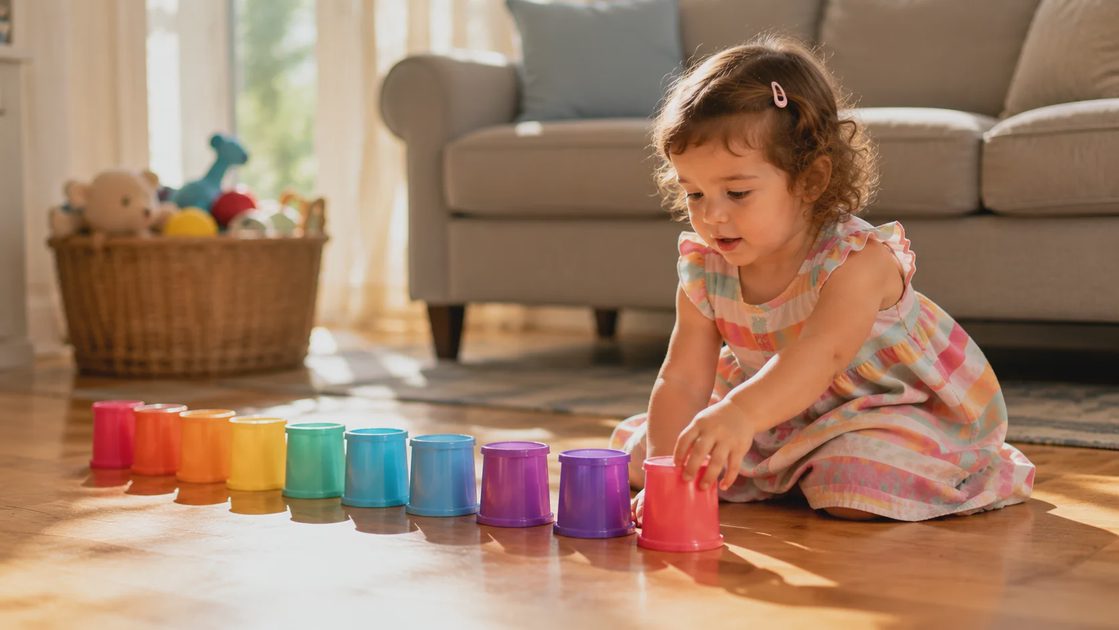
The tipping point came on a Saturday morning. Mae was sitting on the kitchen floor in her pajamas, arranging plastic cups in a line. I grabbed the notebook to log it — "lines up objects, 23 months" — and then I stopped. She looked up at me, and I realized she was not arranging cups to meet a milestone. She was telling herself a story. She was narrating under her breath, placing each cup with intention, completely absorbed. And I was about to reduce that to a checkbox.
I put the notebook down. I sat on the floor next to her. I did not say anything. She handed me a cup, and I placed it in her line. She nodded, satisfied. We sat there for ten minutes, and it was the first time in months I had been with her without evaluating.

The Afternoon I Put the Notebook Down
That Saturday turned into a weekend. Then the weekend turned into a week. I did not throw the notebook away — I am still a teacher at heart, and I still believe in observation. But I stopped checking the chart. I stopped comparing her to the toddler developmental milestones list in my head. I started watching her the way I used to watch my classroom kids — not to assess, but to understand.
What I Saw When I Stopped Counting
When I stopped measuring, I started noticing things the chart could not capture. I noticed that Mae hums when she eats something she likes. I noticed that she brings Ollie his shoes every morning, not because anyone taught her to, but because she wants to be part of the goodbye. I noticed that she sorts her stuffed animals by size before nap — not because a milestone chart told her to, but because it matters to her for reasons I will never fully understand.
None of those things are on any chart. All of them are more interesting than anything on any chart.
What Changed When I Stopped Measuring
Here is what shifted when I let go of the chart:
I stopped searching "is my toddler on track" at midnight
I stopped comparing Mae to Ollie at the same age, which was never fair to either of them
I started sitting on the floor more and observing from across the room less
I noticed her personality — her humor, her preferences, her rhythms — in a way the chart had been crowding out
I trusted her development instead of auditing it
The Teacher Lens vs. the Mom Lens
This is not a rejection of my teacher self. It is a recalibration. Here is how I think about the two lenses now:
Teacher Lens | Mom Lens |
|---|---|
Asks "is this on schedule?" | Asks "what is she telling me?" |
Logs data to catch delays early | Logs moments to remember them |
Compares to developmental norms | Compares to her own past self |
Looks for gaps | Looks for joy |
Uses checklists as tools | Uses checklists as starting points, not finish lines |
I still use my teacher training. When I see something that genuinely concerns me, I still know how to observe and when to ask for help. But the default mode has shifted. The chart is a reference, not a ruler. The notebook is for wonder, not just for tracking.
What I Carry Forward
Mae is two. She is going to keep changing, and I am going to keep watching. But I am watching differently now. I am watching the way she carries three stuffed animals at once because two is not enough. I am watching the way she says "Mama" differently when she is tired versus when she is showing off. I am watching the way she puts her hand on my cheek when she wants my attention, and how that gesture alone could fill an entire page of a notebook if I let it.
The toddler developmental milestones chart is still in my desk drawer. I pull it out when a parent at a workshop asks about age expectations. But at home, with Mae, the chart stays in the drawer. What comes out instead is the notebook — not to check boxes, but to write down the things I do not want to forget. The cup line. The shoe delivery. The humming at the dinner table.
It's a season, not a race. She will walk when she walks, talk when she talks, and stack cups in lines for reasons that are hers. My job is to be on the floor with her when she does, not standing over her with a clipboard. That is the lesson it took me two years and a spiral notebook to learn. I am grateful she was patient enough to teach it to me.



Travellers Write
No letters yet — be the first traveller to write.