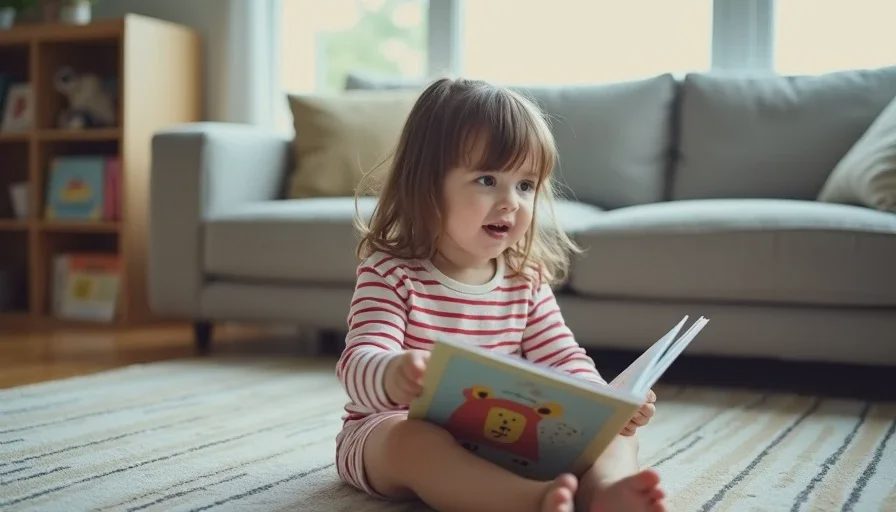
The search query that brings the most worried parents to my inbox is "2 year old not talking." I understand it. When your friend's kid is narrating their entire snack at the park and yours is pointing and grunting, the comparison is sharp. I spent eight years in a preschool classroom watching language develop at wildly different rates, and I am here to tell you: the normal range is much wider than most parents think. But there are real signs worth paying attention to, and knowing the difference between "slow to warm up" and "needs support" is one of the most valuable things I learned as a teacher. A child who is a 2 year old not talking is not automatically behind — but knowing when to act matters.
The Word Explosion: What Actually Happens
Here is the conclusion: between 18 and 30 months, most toddlers go through a language explosion that looks chaotic from the outside but follows a predictable pattern inside. They do not add words one at a time in a neat line. They add them in clusters — ten new words in a week, then nothing for two weeks, then suddenly two-word phrases. The explosion is not a smooth curve. It is a series of jumps.
Expressive vs. Receptive Language
The most important distinction I teach in parent workshops is this: what your child says (expressive language) almost always lags behind what your child understands (receptive language). A two-year-old who says five words but can follow "go get your shoes and bring them to me" is doing something very different from a two-year-old who says five words and also cannot follow a simple direction.
In my classroom, I would watch kids who said almost nothing for months but clearly understood everything — they responded to instructions, pointed to the right pictures when I named them, and laughed at the right moments in stories. Those kids almost always caught up expressively by age three. The kids I worried about were the ones who seemed to understand less, not just speak less.
What Normal Variation Looks Like
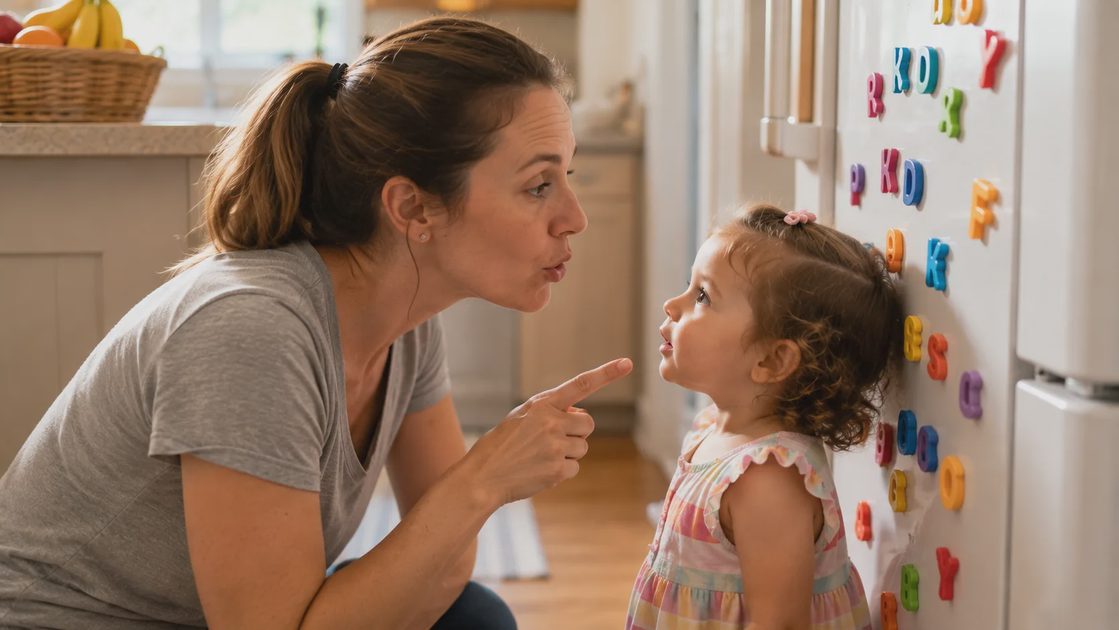
Normal variation in toddler language is enormous. I have seen kids who had 200 words at 20 months and kids who had 12 words at 20 months, and both were typically developing. The timing of the word explosion is not standardized, and trying to force it is like trying to force a growth spurt. What you can do is create the conditions — talk to your child, narrate your day, read together, respond to their attempts — and then wait.
Mae's Language Journey
Mae said her first clear word at 13 months — "mama," naturally, which Mike still pretends did not sting. By 18 months she had maybe 15 words. By 20 months, the field notebook showed she had not added a single new word in three weeks. I was calm about it because I had seen this pattern a hundred times in my classroom, but I logged it anyway. Then at 21 months, she added 20 words in a week. By 22 months she was stringing two-word phrases together: "more milk," "Dada go," "Mae shoes."
My field notebook from that stretch looks like a stock chart — flat, flat, flat, spike. That is what normal looks like. It is not a steady climb. It is a staircase.

Language Milestones 18 to 36 Months
Here is the reference table I use in workshops. These are broad ranges, not deadlines. If your child is on the earlier or later edge of any of these, that alone is not a cause for alarm.
Age | Expressive (What They Say) | Receptive (What They Understand) | Social Use |
|---|---|---|---|
18 months | 10–25 words, mostly nouns and names | Follows simple one-step directions | Points to show, makes eye contact |
24 months | 50+ words, starting two-word phrases | Follows two-step directions | Uses words for needs, imitates adults |
30 months | 200+ words, three-word sentences | Understands position words (in, on, under) | Asks "what" and "where" questions |
36 months | 500+ words, tells short stories | Understands most everyday conversation | Holds back-and-forth conversations |
When to Ask for Help
This is the section parents usually skip to. I understand. Here are the signs that warrant a conversation with your pediatrician or a speech-language pathologist:
No meaningful words by 18 months
No two-word phrases by 24 months (if your 2 year old is not talking at all — zero words — this is the threshold to act on, not wait)
Loss of words or skills they previously had (this is called regression and it always warrants evaluation)
No pointing or gesturing by 15 months
No response to their name by 12 months
Limited or decreasing eye contact
No imitation of sounds or actions by 18 months
Notice what is not on this list: "talks less than my friend's kid" or "only says 30 words instead of 50." Comparison is not a diagnostic tool. If you are concerned, the right move is to ask for an evaluation — not to spend six months on search engines at midnight. Early intervention services are available in every state, and they are easier to access than most parents think.
What I Would Do If I Were Worried
If I were worried about Mae's language, here is what I would do. I would call our pediatrician and ask for a referral to a speech-language pathologist. I would not wait. I would not hope she catches up on her own while logging it in the notebook. The evaluation itself is not a diagnosis — it is information. And information is what lets you make good decisions.
Here is what I would not do: spend hours reading forums about 2 year old not talking at midnight. I would not compare Mae to every kid at the playground. I would not let anxiety build for months without getting real input from a professional who can actually see my child.
It's a season, not a race. Some kids talk early. Some talk late. Some need a little support to get there, and getting that support early makes a difference. None of this means something is wrong with your child. It means development is not a straight line, and sometimes a professional can help you see the path more clearly than a search engine can.



Travellers Write
No letters yet — be the first traveller to write.