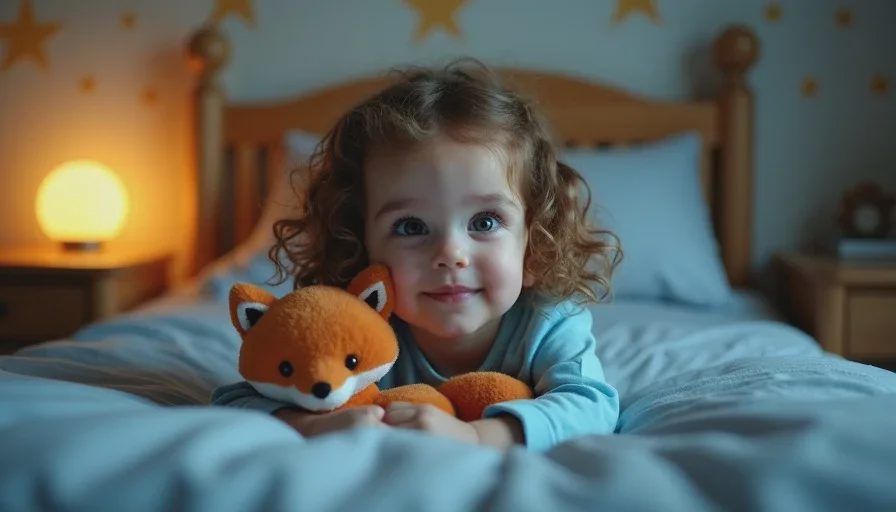
At 3:14 a.m. last Tuesday, I was sitting on the floor of Mae's room, fully reclined against her toy bin, handing her a stuffed fox for the fourth time in an hour. Mae is two. She was wide awake, narrating her dreams to the dark, and completely thrilled about the whole situation. I was not thrilled. This is the 2 year old sleep regression, and it has visited our house more times than I'd like to count — enough that I've learned to recognize it the way I recognize the first gray sky of a Seattle October.
What a Sleep Regression Actually Is
Here's the thing nobody tells you: a sleep regression isn't a sign you did something wrong. It's a sign that something is changing — and for a two-year-old, something is always changing. Their world is expanding at a pace they can't keep up with, and their sleep is where the overflow shows up.
A regression looks like a toddler who was sleeping decently suddenly waking at night, fighting naps, or needing you to stay in the room to fall asleep. It feels like a personal failure. It isn't. In my eight years watching toddlers, I saw the same pattern over and over: a child takes a developmental leap, and for a week or three, sleep pays the price.
Why Two Years Old Is a Common Time
The 2 year old sleep regression is famous because so many things collide at this age. Language is exploding, independence is arriving, and a toddler's imagination is starting to fire up in ways they don't yet know how to manage. Bedtime becomes negotiation hour, and the night wake-ups come with company.
Here's how the different sleep disruptions around this age compare, from what I've seen in my classroom and my own two kids:
Age | What Usually Shows Up | What's Driving It |
|---|---|---|
Around 12 months | Walking practice at night, standing in the crib | New motor skill rehearsal |
Around 18 months | Bedtime refusals, calling for you repeatedly | Separation awareness, language jump |
Around 2 years | Night wake-ups, "one more book," stalling at bedtime | Language explosion, new fears, big feelings |
Around 3 years | Refusing naps, bedtime power struggles | Growing independence, dropping to one nap |

What's Happening in the Toddler's Head
It helps me to think about what two-year-olds are processing. Because none of it looks like "just being difficult."
The Language Explosion
Between two and three, toddlers can go from a handful of words to sentences in what feels like weeks. That's a lot of wiring happening in a small head. Children this age are literally learning new words while they're asleep — and sometimes the learning wakes them up. Mae will shout "fox!" or "banana!" at 2 a.m. like she's confirming the world still exists. It's funny in the daylight. It's less funny at 2 a.m. But it's a marker of the growth underneath the wake-up.
Separation and the New Imagination
Two is also when the idea of "you're not here" becomes real and scary. A toddler who once slept through anything now wakes, calls for you, and needs to hear your voice or see your face to settle. Add a newly active imagination — shadows, sounds, the shape of a jacket on the hook — and you have a recipe for a child who genuinely doesn't want to close their eyes alone.
All of this is normal. It's also exhausting. Let me say that plainly: you can understand the reasons fully and still be running on fumes. Understanding the 2 year old sleep regression doesn't make the 3 a.m. wake-up easier on your body. It just makes it easier on your heart.

What Actually Helped Us at 3 a.m.
I'm not going to tell you which sleep method to use. I've watched the sleep-training versus attachment debate split parent groups for years, and I've seen families succeed on both sides and everywhere in between. What I can give you is the neutral ground — the strategies that helped us through Mae's regressions without me having to pick a camp.
Here's what we did, in order of how much it helped:
We stopped negotiating at bedtime. We held the routine we could actually repeat every night — bath, two books, lights, a song — and kept it short. Boredom is a better sleep cue than excitement.
We set a quiet rule during night wake-ups. No screens, no bright lights, no big conversations. Just a calm voice, a back rub, and the same one or two sentences. "It's still night. The fox is here. I'm here."
We made sure daylight was real. On the days we managed it, a walk around the neighborhood in the morning — even a short one around the block — did more for the next night's sleep than anything we tried at bedtime.
We took turns. Mike and I split the night wakes, not as a schedule, but as a lifeline. One of us gets the midnight shift, the other gets the 3 a.m. shift. Nobody feels like the only one awake.
We moved the bedtime later for about a week when naps got weird, then moved it back. A toddler who's overtired sleeps worse, not better.
We picked a response and stayed consistent for two weeks. The toddlers I watched in my classroom were at their calmest when the adults around them were predictable — and the same was true for Mae at home.
None of this made the regression disappear overnight. But it kept it from turning into months, and it kept me sane enough to be the calm person a two-year-old needs in the middle of the night.
When It's Not Just a Regression
I want to be honest about the edge of this too. Sometimes what looks like a 2 year old sleep regression is a different puzzle:
If the wake-ups come with loud breathing, snoring, or long pauses in breathing, check in with your pediatrician
If your toddler is clearly in pain — think ear pulling, teething molars, or a cough — treat the pain before you treat the sleep
If naps have disappeared entirely and the nights are still rough, it might be time to adjust the whole day's rhythm rather than push through
The Season of the 3 a.m. Fox
Here's what I want you to take with you: a sleep regression is a season, and seasons end. The 2 year old sleep regression felt, in the middle of it, like it might be the rest of my life. It wasn't. Ollie's regressions ended. Mae's regressions end. Every toddler I watched in my classroom eventually slept through the night, and so did their parents — most of them without any dramatic method, just consistency and time.
I write every wake-up in my toddler field notebook, in the same shorthand I used for my classroom kids: "3:14am — awake, chatty, fox required." And on the mornings after, I read the pattern back and remind myself: It's a season, not a race. The 3 a.m. fox won't be here forever. Neither will the wake-ups. Keep the lights low, keep your voice calm, and keep taking turns with your partner. That's the whole of what actually helps.



Travellers Write
No letters yet — be the first traveller to write.