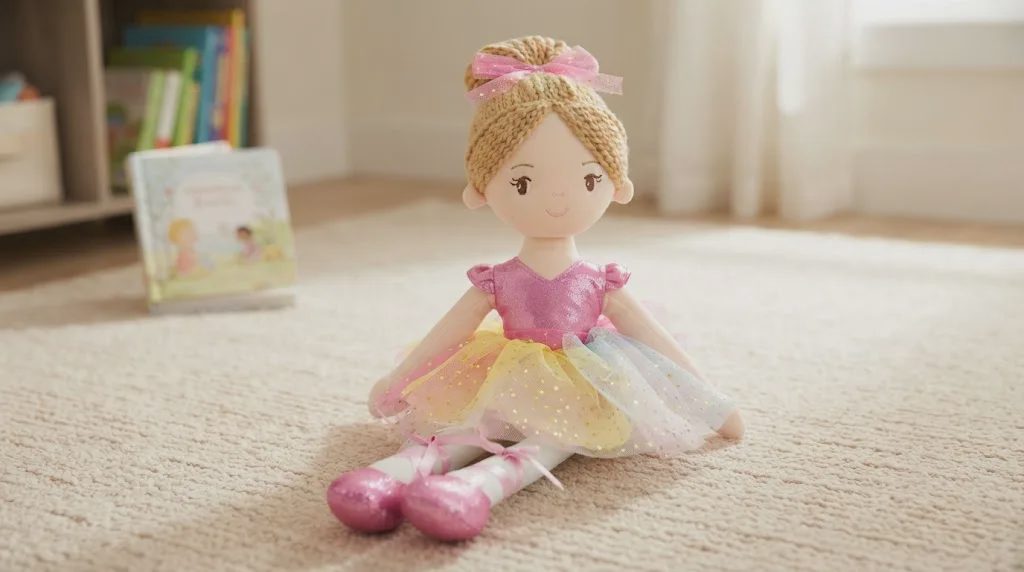
Mae turned two and a half and every soft toy in the house suddenly had a new job. The unicorn had to “dance.” The bear got propped against the couch for “rehearsal.” None of them looked the part, and she noticed. After watching her big brother’s school recital, she spent the evening asking why she didn’t have a “dance friend” of her own. That small, insistent question is what started this—not a shopping list.
I brought home a 16-inch cloth ballerina doll for $21.99. What I wanted to see was not whether the doll was “worth it.” I wanted to watch what a two-year-old would actually do with a character that looked ready for a studio. I wrote a few notes in my notebook that night, mostly so I wouldn’t forget the exact words she used.
See current details and reviews
Why Pretend Play Looked Different at Two
After eight years in preschool classrooms, I’ve watched toddlers turn ordinary objects into characters almost every day. At home the same thing happens, only the audience is smaller and the “studio” is the open space between the couch and the coffee table.
Around this age, I started seeing pretend play shift from simple hugging or carrying toward giving an object a clear role. Mae didn’t just want something soft. She wanted something that could be the student, the performer, or the friend who needed to practice. A regular stuffed animal could be loved, but it didn’t easily support the small sequence she was already trying to invent: get ready, do the class, finish with a bow.
That sequence—prepare, act, close—is one of the ways I’ve seen two-year-olds begin to organize their own pretend play. It doesn’t require flashcards or adult direction. It just needs a prop that invites the story.
What Helped Her Play Independently
I wasn’t looking for a perfect developmental tool. I was looking for something that matched how Mae already played:
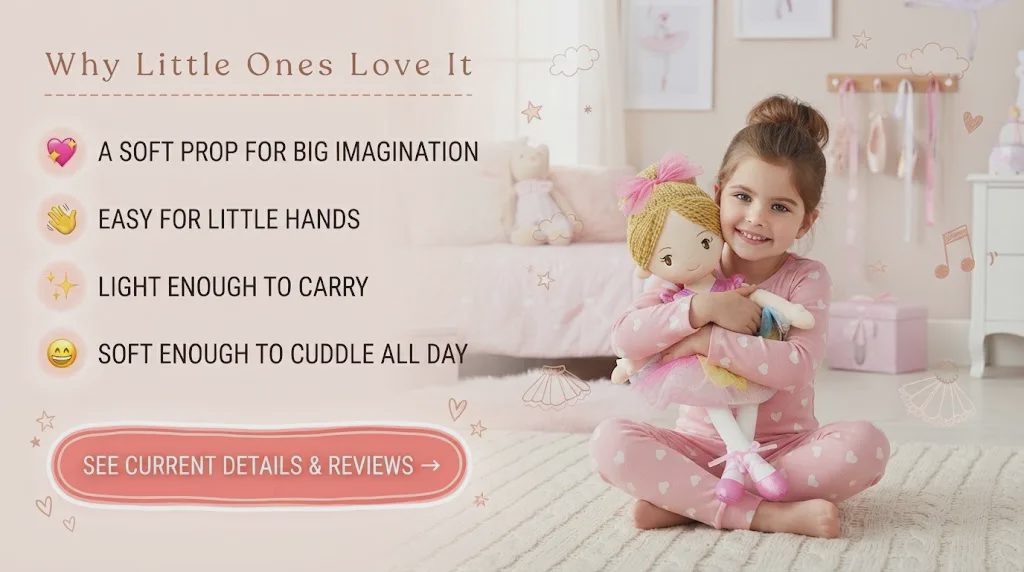
Easy for a two-year-old to carry without dragging
Soft enough to cuddle all day
Nothing that falls off or comes loose
Clear visual cues that support a simple role
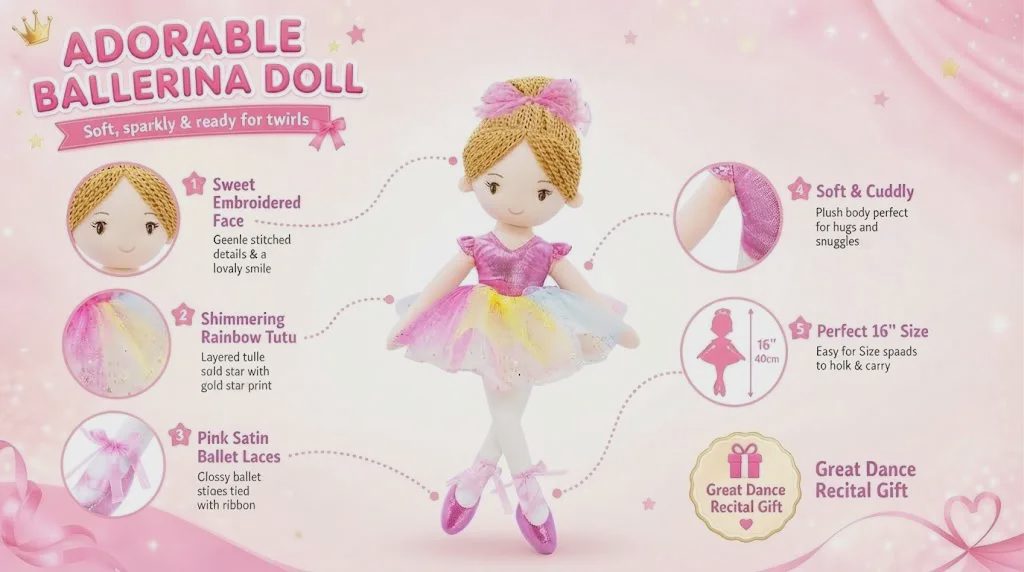
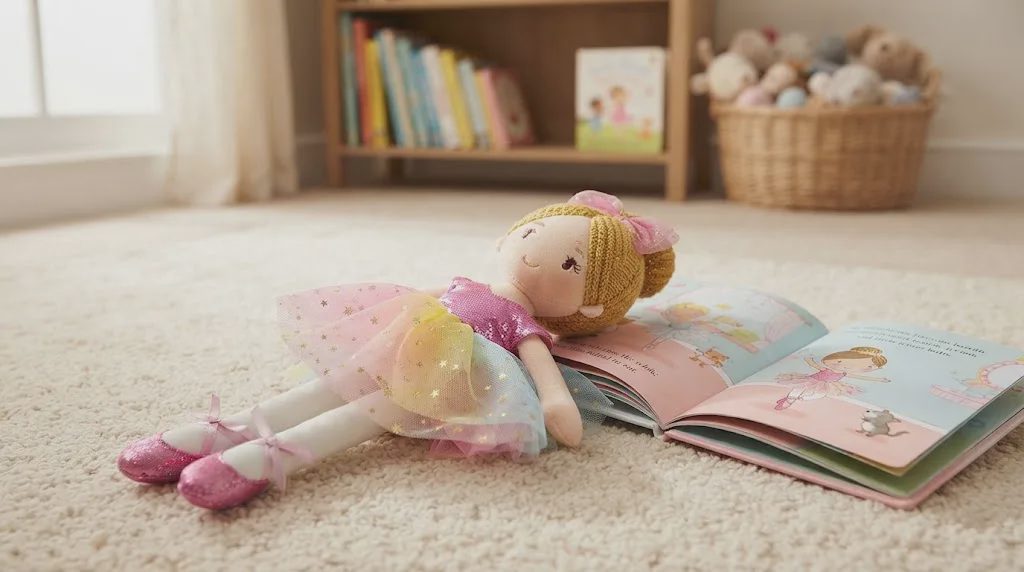
The doll happened to have those qualities: light enough to hold in one arm, yarn hair that stays manageable, an embroidered face, and a sewn-on tutu. Those details only mattered because they made independent pretend play easier for her.
See current details and reviews
What the Play Actually Looked Like
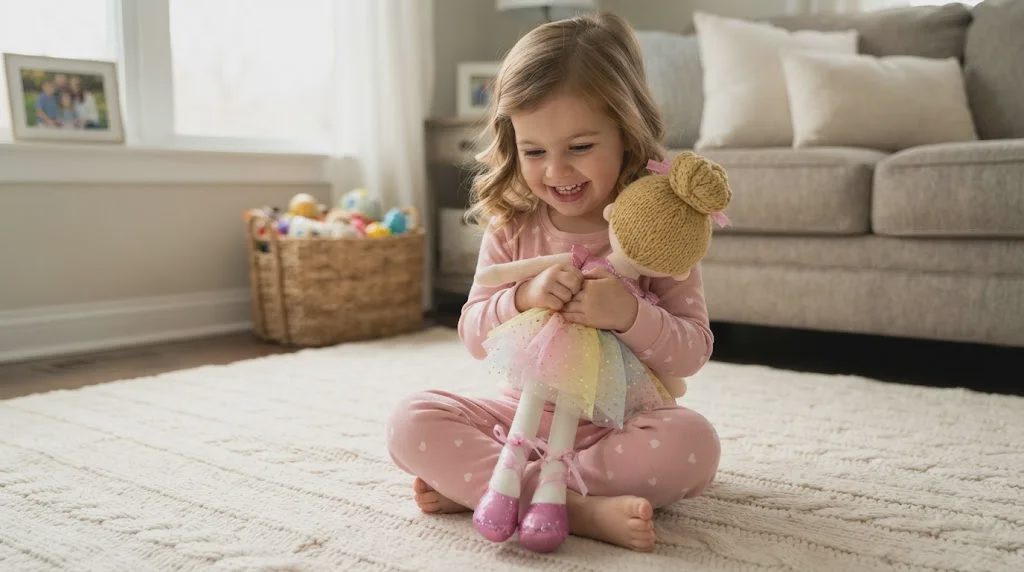
I kept the doll tucked away until after Ollie’s recital, then handed it to Mae as a small surprise for the little sister who had watched the whole show. She carried it for the rest of the evening. By the next morning it was already in the living-room “studio.”
What I noticed was how little instruction she needed.
She smoothed the yarn hair before “class.”
She adjusted the tutu, then made the doll stand ready.
She moved the doll through a short routine.
At the end she made the doll bow.
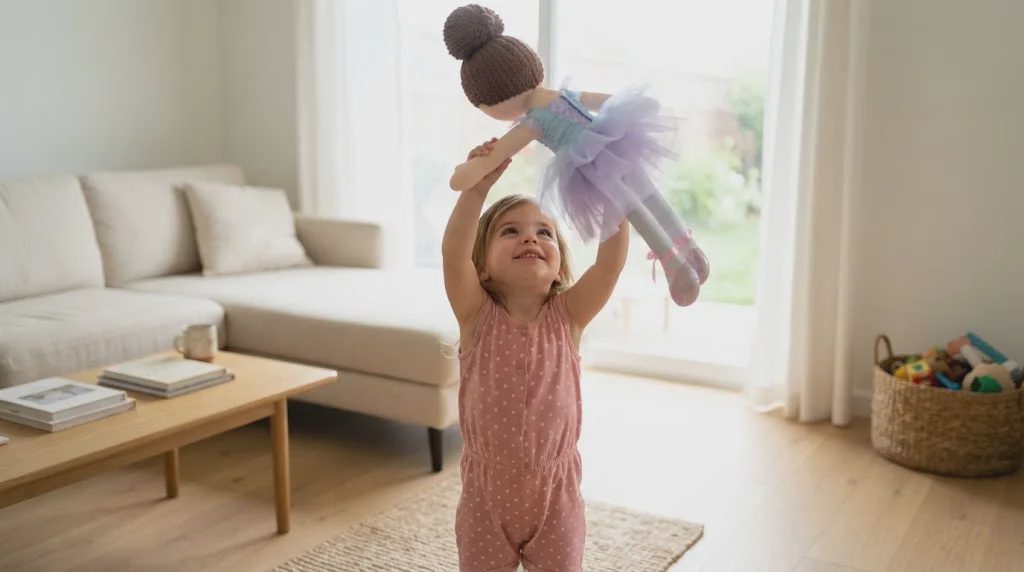
Those four steps—prepare, set up, perform, finish—happened without me prompting. She also gave the doll a clear job. It wasn’t only something to hug; it was the student or the friend who needed practice. Short bits of language came with the action as she narrated the story out loud while walking the doll from the couch to the open floor and back.
A week later I noticed the same sequence had become part of quiet-time play. The doll came to breakfast, sat beside story time, ended up under the couch more than once, and sometimes became a pillow. That kind of ordinary, all-day presence is what pretend play looked like in our house.
Ollie, who is six, occasionally joined. What surprised me was that they didn’t play the same way. Mae gave the doll a character and a short story. Ollie gave it a role inside a larger game he was already running. Two different ages, two different versions of the same prop—both fine.
I didn’t teach her a ballet sequence. I didn’t set up stations or ask her to complete any steps. She built the story herself. That is the part that stayed with me.
What I Noticed as a Former Preschool Teacher
In the classroom I used to see the same pattern: once a toddler assigns a role, the play often expands on its own. The prop doesn’t create the learning. The child’s idea does. The doll simply gave Mae a clearer character to work with.
I also noticed she could carry the whole sequence without help. That independence—deciding the order, moving the doll, finishing the story—is more useful to watch than any single product claim. Some two-year-olds do this with cars, blocks, or a simple spoon. Others do it with a character that looks ready for a stage. Neither is “ahead” or “behind.” It’s just how this particular child was playing right now.
What Held Up in Daily Life
After several weeks of real use the doll had become part of the ordinary rhythm of the house. It came to breakfast. It sat beside story time. It ended up under the couch. It was used as a quiet-time pillow. The yarn hair stayed manageable. The sewn-on tutu stayed attached through spinning and carrying. At a size and weight a two-year-old can manage in one arm, Mae could take it from room to room without help.
See current details and reviews
Where the Doll Falls Short
This is still a cloth doll. The arms and legs have limited range, so it will not hold a true dance pose or sit independently in many positions. If a child wants a doll that can be arranged for photos, this one will not do that. The tutu collects lint and the occasional pet hair; a quick brush once a week keeps it presentable.
It is also not an heirloom piece. Soft, play-friendly materials show wear with daily use. For the roughly 18-month to four-year window of active pretend play, that trade-off has made sense here. I would not expect it to look new after two full years of constant carrying.
What to Look For in Any Pretend-Play Toy
When I look at toys for this stage now, I ask:
Can the child carry it themselves?
Does it invite a role or a short story without adult setup?
Are there small loose pieces that can come free?
Can the child interact with it without constant help?
Does it fit how this particular child already likes to play?
Those questions matter more than brand or exact features. They keep the focus on the child’s actual pretend play instead of the product page.
Who Might Enjoy This—and Who Might Not
This kind of doll has fit our house because Mae is deep in imaginative play and already interested in dance-class stories. It can be a good fit for children in this general age range who like to carry a character, give it a job, and act out short sequences.
Some two-year-olds prefer cars, blocks, cause-and-effect toys, or simple construction. That is just as typical. Preferring one kind of play over another is not a milestone to worry about. If your child is still mostly mouthing toys, needs a doll that can be posed, or mainly reaches for building toys, a different prop will probably match their play better.
The Bottom Line: It’s About the Play, Not the Toy
The doll gave Mae a character that matched the stories she was already telling. It is soft, light, and simple enough for independent pretend play. It is not a high-end collectible and it will not pose like an articulated fashion doll. For a toddler who wanted a dance friend she could carry from the couch to the kitchen, it has worked well in daily use.
What stayed with me was watching a two-year-old invent the class, the performance, and the bow without any instruction. She smoothed the hair, adjusted the skirt, made the doll ready, and finished with a bow—small, self-directed steps that turned an ordinary afternoon into a living-room recital.
Some children do this with a ballerina doll. Others do it with a truck or a wooden spoon. Both are normal. It’s a season, not a race—and right now this particular season includes a lot of living-room recitals. The doll simply gave those recitals a clearer lead.


Travellers Write
No letters yet — be the first traveller to write.